Gaming market melts down after Google reveals new AI game design tool — Project Genie crashes stocks. (A.K.A . Investors panic because they don't understand what "real" videogames are)
-
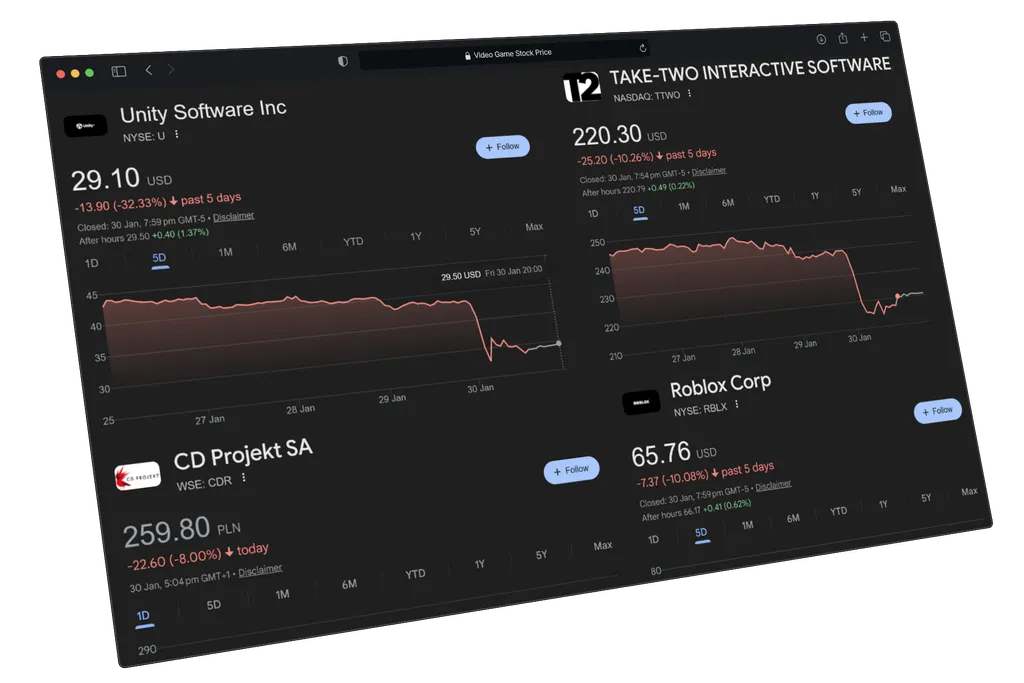
Yesterday, Google announced Project Genie, a new generative AI tool that can apparently create entire games from just prompts. It leverages the Genie 3 and Gemini models to generate a 60-second interactive world rather than a fully playable one. Despite this, many investors were scared out of their wits, imagining this as the future of game development, resulting in a massive stock sell-off that has sent the share prices of various video game companies plummeting.
The firms affected by this include Rockstar owner Take-Two Interactive, developer/distributors like CD Projekt Red and Nintendo, along with even Roblox — that one actually makes sense. Most of the games you find on the platform, including the infamous "Steal a Brainrot," are not too far from AI slop, so it's poetic that the product of a neural network is what hurt its stock.
Unity's share price fell the most at 20%, since it's a popular game engine. Generally speaking, that's how most games operate: they use a software framework, such as Unity or Unreal Engine, which provides basic functionality like physics, rendering, input, and sound. Studios then build their vision on top of these, and some developers even have their own custom in-house solutions, such as Rockstar's RAGE or Guerrilla's Decima.
i wish i knew how to use this stupidity, but i dont know what stock would be useful to get. I dont want to buy anything from america, ubisoft is bad investment always anyway and only finnish game company i can think/find doesnt even seem affected.
-
Yesterday, Google announced Project Genie, a new generative AI tool that can apparently create entire games from just prompts. It leverages the Genie 3 and Gemini models to generate a 60-second interactive world rather than a fully playable one. Despite this, many investors were scared out of their wits, imagining this as the future of game development, resulting in a massive stock sell-off that has sent the share prices of various video game companies plummeting.
The firms affected by this include Rockstar owner Take-Two Interactive, developer/distributors like CD Projekt Red and Nintendo, along with even Roblox — that one actually makes sense. Most of the games you find on the platform, including the infamous "Steal a Brainrot," are not too far from AI slop, so it's poetic that the product of a neural network is what hurt its stock.
Unity's share price fell the most at 20%, since it's a popular game engine. Generally speaking, that's how most games operate: they use a software framework, such as Unity or Unreal Engine, which provides basic functionality like physics, rendering, input, and sound. Studios then build their vision on top of these, and some developers even have their own custom in-house solutions, such as Rockstar's RAGE or Guerrilla's Decima.
Hmmm. let's build something we know and take some time, and know how to modify and build off it, or! we could spitball into the shit machine and it can shit us out a shit we don't know how any of the shit in it works and then spend twelve times as long untangling its web. SHIT MACHINE AHOY!
-
no these are a bunch of dips making it happen
-
It’s Google, so it will last two years MAX.
I have no idea why people and companies still trust Google. When I did work on GCP we had mandatory maintenance every 2 months because some core service was changing. Hell I just got a notice last week that they're shutting down another API.
-
- Step 1 : buy some shares that fell down
- Step 2 : Wait for the IA fuckery to collapse
- Step 3 :
- Step 4 : profit
Yep, gaming stocks are on sale today because of stupid investors. Happily bought a few
-
That's all it does so far.
But I doubt AI games will succeed, people are always going to want the human touch when it comes to art.
There will be a demand but I wouldn't bet on that demand being the most popular.
-
If this is widely adopted, I have enough emulators and classic PC games to never buy another game in my life and still be entertained the whole time. Good luck, corpo dipshits.
I'll still buy from principled indie devs any day any year. There may be more old games than anyone could play in a single lifetime but let's be real most aren't good.
-
Investors never played a real video game. They dont undestand the difference between video (ai generated) and a video game.
Some of them tried to make video games, and that's how they ended up with web3 and play-to-earn bullshit. Remember those? Barely? Yeah, same.
-
Genie is pretty cool as it stands from a technical standpoint, but... 1 minute of some really, really bottom tier walking simulator gameplay is not going to destroy the gaming market.
Investors are so easily manipulated.
It's an initial proof-of-concept. It'll be developed into more complex games eventually, that's not really an issue for it
The main issue is that it's just a facade. It completely lacks the foundation required for a game. It's a world without hard rules, which is a terrible experience for any user. The game isn't determining cause and effect from actions. It's just guessing at what would come next
What's the point of decorating an in-game house if the next time you go there, the AI forgot what was supposed to be there?
What's the point of completing quests if the AI forgets what you've completed?
What's the point of getting new gear if AI hallucinates what gear you have?
There is no progress in an AI generated game because everything is made up as it goes. Google would need to fundamentally change their approach to allow for that
That being said, this and similar technologies could be used to add really cool mechanics in a game that previously weren't feasible. The ability to add a temporary dream-like or watercolor aesthetic easily would be great for small developers to tell stories
-
Yesterday, Google announced Project Genie, a new generative AI tool that can apparently create entire games from just prompts. It leverages the Genie 3 and Gemini models to generate a 60-second interactive world rather than a fully playable one. Despite this, many investors were scared out of their wits, imagining this as the future of game development, resulting in a massive stock sell-off that has sent the share prices of various video game companies plummeting.
The firms affected by this include Rockstar owner Take-Two Interactive, developer/distributors like CD Projekt Red and Nintendo, along with even Roblox — that one actually makes sense. Most of the games you find on the platform, including the infamous "Steal a Brainrot," are not too far from AI slop, so it's poetic that the product of a neural network is what hurt its stock.
Unity's share price fell the most at 20%, since it's a popular game engine. Generally speaking, that's how most games operate: they use a software framework, such as Unity or Unreal Engine, which provides basic functionality like physics, rendering, input, and sound. Studios then build their vision on top of these, and some developers even have their own custom in-house solutions, such as Rockstar's RAGE or Guerrilla's Decima.
I see a couple of major practical reasons why game (engine) devs are under no threat from this even if it gets better in the future:
-
Scale. Like all things AI, this is not going to scale well. This doesn't generate code, 3D models and textures, both making games and playing them requires running the model. So if you want a game to have a persistent environment where the world behind you doesn't get regenerated into something different after taking 8 steps, the context window is going to get real large real fast. And unlike programmed games, you can't make choices about what's worth remembering and what isn't, what can be kept on persistent storage and is only loaded when it becomes relevant etc., because it's all one big, opaque blob of context, generated by a black box; you either have it remember everything or it becomes amnesiac in a way that makes it useless. Memory availability also isn't increasing at a rate where this becomes a non-issue any time soon.
-
Control. Manipulating the world though a text prompt gives a lot of control, but it's also very course. It's easy enough to tell it that you want a character that can run and jump, but how fast does it run? Does it accelerate and decelerate or start and stop instantly? Does it jump in a fixed arc or based on the running speed and duration of the jump button being pressed? How far and how high? You're going to run in the limits both of what you can convey and what the language model will understand pretty quickly. And even when you can get it to do exactly what you want, it would have been faster and more practical to manipulate values directly or use a gizmo place things. But there's no way to extract and manipulate those values, because again: big, opaque blob of context.
-
-
It's an initial proof-of-concept. It'll be developed into more complex games eventually, that's not really an issue for it
The main issue is that it's just a facade. It completely lacks the foundation required for a game. It's a world without hard rules, which is a terrible experience for any user. The game isn't determining cause and effect from actions. It's just guessing at what would come next
What's the point of decorating an in-game house if the next time you go there, the AI forgot what was supposed to be there?
What's the point of completing quests if the AI forgets what you've completed?
What's the point of getting new gear if AI hallucinates what gear you have?
There is no progress in an AI generated game because everything is made up as it goes. Google would need to fundamentally change their approach to allow for that
That being said, this and similar technologies could be used to add really cool mechanics in a game that previously weren't feasible. The ability to add a temporary dream-like or watercolor aesthetic easily would be great for small developers to tell stories
It's an initial proof-of-concept. It'll be developed into more complex games eventually, that's not really an issue for it
Except it is an issue, just one being masked by the mountains of cash these companies are burning to provide AI. To increase the depth and complexity and actually store state would require orders of magnitude more energy, compute, memory and storage. The AI bubble is causing very single one of those to become more expensive. At some point the market will call bullshit on these companies ("show us profit, or at least exponential revenue growth, or line go down"), at which point these companies will attempt to download the costs onto their users. When people see the bill and realize what these services actually cost, the whole thing is gonna collapse like a flan in a cupboard.
-
3ds and DS cartridges both have a limited lifespan and are likely to experience save failure as the years pile on - have you considered hacking your 3ds and getting a flashcart for DS games?
(You also won't be giving money to scalpers on ebay)
-
Selling games from 10-20 years ago isn’t scalping.
-
I have 15 Nintendo handhelds on my last count. 2 of the 3ds are modded.
-
I have a pretty sizable collection and I’ve not had a game die on me yet, aside from save batteries that I’m capable of changing. I know the games can eventually die, I know it’s on the horizon, but they all still work for now, and I think even after they die I’ll enjoy the memories that the physical media provided me.
-
-
Welcome to the stock market: where the money's made up and the rules don't matter!
Always has been.
Remember when Elon had to buy Twitter?
Prior to that, he was manipulating the market through Twitter causing a lot of uncertainty.
-
This will never be widely accepted in the gaming space because it's not a game. The model only generates an interactive world, not a game world. It's effectively a glorified AI prompted showroom. It's useless as a development tool because nothing it generates is usable in the traditional development process which means the model would have to create the whole game but the model is incapable of understanding what a game is.
It’s good enough for shovelware alredy.
-
-
Selling games from 10-20 years ago isn’t scalping.
-
I have 15 Nintendo handhelds on my last count. 2 of the 3ds are modded.
-
I have a pretty sizable collection and I’ve not had a game die on me yet, aside from save batteries that I’m capable of changing. I know the games can eventually die, I know it’s on the horizon, but they all still work for now, and I think even after they die I’ll enjoy the memories that the physical media provided me.
- Retro games can totally on the market for completely unreasonable prices, look at any of the NDS pokemon games for a quick point of reference - especially insulting compared to the ease of using a flashcart.
- Damn, you're one of those hardcore collectors. I'm just the kind of person that bought a 3ds for the unique hardware layout and emulate the rest of Nintendo's handhelds on my Steam Deck, but different strokes I guess.
- The 3DS carts I believe are the most prone to failure - most of what I read comes from the Animal Crossing and Pokemon communities (probably due to their dedicated fanbases), so that'd be the primary concern. Considering you can regularly rip your carts using a modded 3DS, staying ahead of it would probably be wise (I'm not hatin' on the collection, but even diehard physical media collectors should rip their copies for safety).
-
-
I see a couple of major practical reasons why game (engine) devs are under no threat from this even if it gets better in the future:
-
Scale. Like all things AI, this is not going to scale well. This doesn't generate code, 3D models and textures, both making games and playing them requires running the model. So if you want a game to have a persistent environment where the world behind you doesn't get regenerated into something different after taking 8 steps, the context window is going to get real large real fast. And unlike programmed games, you can't make choices about what's worth remembering and what isn't, what can be kept on persistent storage and is only loaded when it becomes relevant etc., because it's all one big, opaque blob of context, generated by a black box; you either have it remember everything or it becomes amnesiac in a way that makes it useless. Memory availability also isn't increasing at a rate where this becomes a non-issue any time soon.
-
Control. Manipulating the world though a text prompt gives a lot of control, but it's also very course. It's easy enough to tell it that you want a character that can run and jump, but how fast does it run? Does it accelerate and decelerate or start and stop instantly? Does it jump in a fixed arc or based on the running speed and duration of the jump button being pressed? How far and how high? You're going to run in the limits both of what you can convey and what the language model will understand pretty quickly. And even when you can get it to do exactly what you want, it would have been faster and more practical to manipulate values directly or use a gizmo place things. But there's no way to extract and manipulate those values, because again: big, opaque blob of context.
Wish I could upvote your comment more than once. Thank you for the injection of clarity.
-
-
Examples? This article describes "a 60-second interactive world". How can this even compete with trash tier roblox games?
-
Yesterday, Google announced Project Genie, a new generative AI tool that can apparently create entire games from just prompts. It leverages the Genie 3 and Gemini models to generate a 60-second interactive world rather than a fully playable one. Despite this, many investors were scared out of their wits, imagining this as the future of game development, resulting in a massive stock sell-off that has sent the share prices of various video game companies plummeting.
The firms affected by this include Rockstar owner Take-Two Interactive, developer/distributors like CD Projekt Red and Nintendo, along with even Roblox — that one actually makes sense. Most of the games you find on the platform, including the infamous "Steal a Brainrot," are not too far from AI slop, so it's poetic that the product of a neural network is what hurt its stock.
Unity's share price fell the most at 20%, since it's a popular game engine. Generally speaking, that's how most games operate: they use a software framework, such as Unity or Unreal Engine, which provides basic functionality like physics, rendering, input, and sound. Studios then build their vision on top of these, and some developers even have their own custom in-house solutions, such as Rockstar's RAGE or Guerrilla's Decima.
Why does Google keep trying to make AI, when they're soooo bad at it, and pretty much everything else they do?
-
- Retro games can totally on the market for completely unreasonable prices, look at any of the NDS pokemon games for a quick point of reference - especially insulting compared to the ease of using a flashcart.
- Damn, you're one of those hardcore collectors. I'm just the kind of person that bought a 3ds for the unique hardware layout and emulate the rest of Nintendo's handhelds on my Steam Deck, but different strokes I guess.
- The 3DS carts I believe are the most prone to failure - most of what I read comes from the Animal Crossing and Pokemon communities (probably due to their dedicated fanbases), so that'd be the primary concern. Considering you can regularly rip your carts using a modded 3DS, staying ahead of it would probably be wise (I'm not hatin' on the collection, but even diehard physical media collectors should rip their copies for safety).
Yeah man, the prices are unfortunate, but supply and demand is definitely a thing. Items are only worth what people are willing to pay, and I’m fortunate to be able to justify some of my expendable income on growing my collection here and there.
If you really want your head to hurt, look up some of those really popular games sealed and WATA/PSA graded. Old graded consoles still sealed can sell for 6 digits.
I definitely have several of my favorites ripped for a rainy day. It’s definitely not a hobby for everyone. I have more modern emulation machines that can easily run all of my backups, but there’s really no replacement for the real games on real hardware. Just like some people are audiophile vinyl collectors who thumb their nose at Spotify and a pair of ear buds.
-
Yesterday, Google announced Project Genie, a new generative AI tool that can apparently create entire games from just prompts. It leverages the Genie 3 and Gemini models to generate a 60-second interactive world rather than a fully playable one. Despite this, many investors were scared out of their wits, imagining this as the future of game development, resulting in a massive stock sell-off that has sent the share prices of various video game companies plummeting.
The firms affected by this include Rockstar owner Take-Two Interactive, developer/distributors like CD Projekt Red and Nintendo, along with even Roblox — that one actually makes sense. Most of the games you find on the platform, including the infamous "Steal a Brainrot," are not too far from AI slop, so it's poetic that the product of a neural network is what hurt its stock.
Unity's share price fell the most at 20%, since it's a popular game engine. Generally speaking, that's how most games operate: they use a software framework, such as Unity or Unreal Engine, which provides basic functionality like physics, rendering, input, and sound. Studios then build their vision on top of these, and some developers even have their own custom in-house solutions, such as Rockstar's RAGE or Guerrilla's Decima.
The pigs oink and squeal for more slop, and the market trembles.